May I Introduce: Alien

The residents of Kassel get prepared: they cover their rain pipes, they fiddle around locking their trash bins and block every possible point of entry. Raccoons are all over the town Kassel, the "raccoon capital" of Europe.Though our human-raccoon relationship is full of ambivalence.
We hate them for their noise when digging through our trash and for their poo they leave on our porch. We love them for their trap happy faces, their creative problem solving skills and their nimble little hands.But the raccoon is more than just an uninvited guest. Initially shipped all the way from Canada for its soft and fluffy fur it was then released into the European wilderness on purpose to diversify our local fauna. An attempt to fill the void of all the bigger mammals that went extinct over the decades turned into what we call now "an invasive species".
As much as they annoy us, their excellent survival skills and omnivorous eating behaviour means no good for a variety of animal species in our wilderness. Ground nesting birds and the European pond slider turtles often become victims to the raccoon’s eating behaviour.But the raccoon is also a synanthrope – a wild animal that thrives in close proximity to human environments – always in search of the easiest way to grab a snack – which is mostly found inside a trash bin.Scientists agree: raccoons are part of Kassel now and might expand their territory to many more cities in Europe over the next decades. It’s about time for us to rethink how to survive and thrive together.
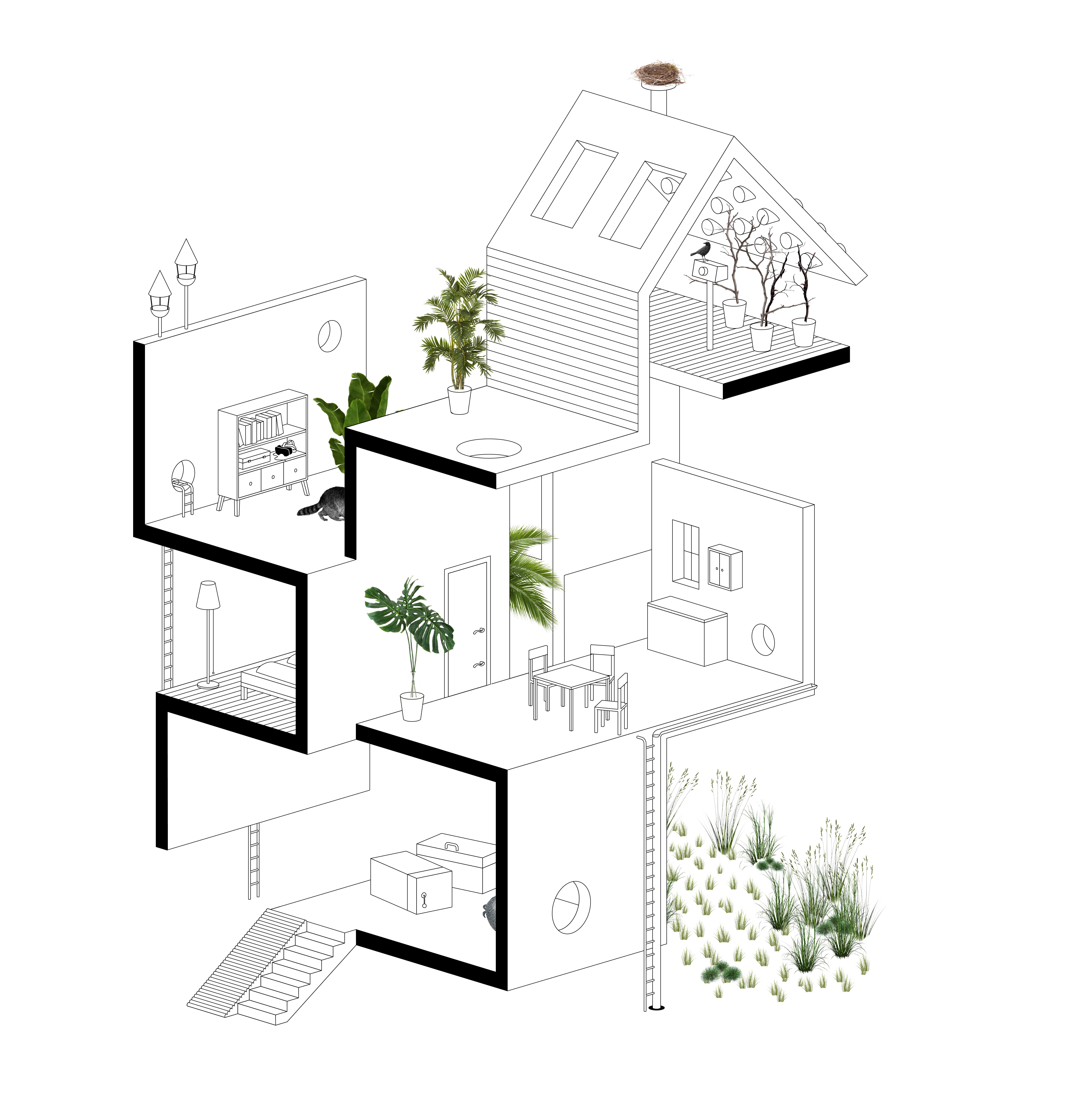
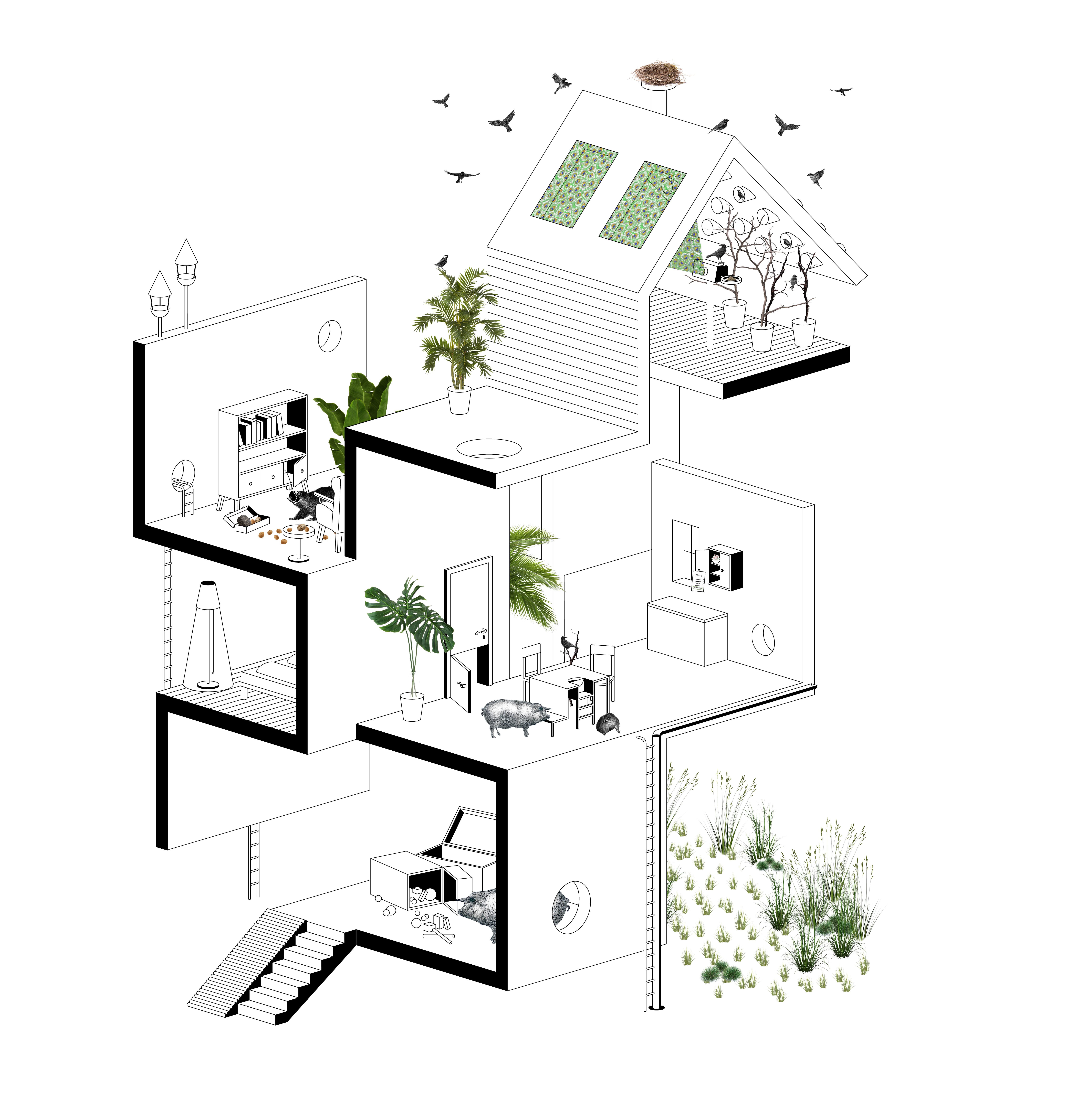
The home in 2025 becomes a space for collaboration and interspecies learning experiences. By engaging in experimental training environments we will help our masked companions to work out an eco sensitive approach for dining out in the wilderness.From multispecies dining setups at the kitchen table to virtual training environments with latest VR technology - in this near future home we work with the raccoon on tweaking its behaviour to protect other species - and we might learn something too!
I hear a clacking sound while I walk across the road. A nut just landed in the middle of the street waiting for the wheels to crack it open. An encounter with another species, able to plan their next move - just the way we do.Them almost quietly using us reverses our too well known relationships we usually establish with the other critters on earth –using them – in a refreshing manner.
The famous nature-culture divide has long started to blur. In times were humans are capable of modifying entire biological processes and even design creatures from scratch the term ‘natural’ has nothing more to do with ‘untouched by man’.Though it’s becoming more evident – this is not a one way track. Not only the anthropos is responding to the natural world. The crow has adapted and since makes the best of the dominant presence of those two armed and two legged mammals filling up all their spaces with concrete. Still they nearly blend into our urban environments mostly unnoticed.
Also mostly unnoticed remains: They build tools to solve problems, they hold funerals for their dead companions, and they remember their enemies and most probably tell their friends about it.It’s hard to believe those personality traits are the ones of a feathered creature that doesn’t even have hands.They also bring you shiny presents if you treat them well. Which might mean they could have a feeling for beauty, just as we humans do.
In the HOME IN 2025 we work together with crows to set up spectacles for our feathered companions!
a door for crawling critters and cawing creatures alike
a user friendly light source for night active critters depending on vision
Inviting climbing aid for raccoons to enter easily. A friendly alternative to hostile rain pipe architecture that's available on the market.
preventive health toolkit for a diversity of intestinal biomes and parasites.
Marshmallows turned out to be preferred by raccoons.
alternative stairs for pigs and species with short legs
Dirty like a pig, sweating like a pig or eating like a pig. Pigs are victims of many attributions throughout human cultures from East to West.Science shows they are quite the opposite: They are some of the cleanest species on the planet, they don’t even have sweat glands, and they preferably dine on fine fungus like truffles.Also they play with their friends, are easily bored, recognize their names and enjoy massages and music. They laugh with grunts and can suffer from depression.
They even have eyelashes, just like we do.Still we mostly enjoy them as bacon.Pigs are from a genetic point of view very close relatives to us. Researchers call them “horizontal humans” bearing spare parts. A pig can save your life, which by the way means in reverse also your heart fits into a pig - so are we maybe “vertical pigs”?Philosopher Peter Singer radically questions what we consider human exceptionalism. He popularised the term speciesism - the neglection of the interests of other animals. Singer argues if the moral value of each organism is measured by its abilities, not all humans differ so much from other animals, but only the ones with higher cognitive abilities. So should we eat toddlers?
Author Carl Safina argues that if we take a closer look into the everyday life of other species we might notice that “a vivid, familiar life is not the domain of humans alone.”Not only the ethical double standard should make us question the utilisation of animals especially on a mass production scale. A planet at the limits of its resources urges us to think about other forms of coexistence and connection beyond consumption.
In the HOME IN 2025 we get to know pigs through collective play and pleasure, and they can get to know us.
an inclusive table for the needs of all inhabitants: a water bowl for the
raccoon, a lower table part for the pig, and a branch table leg for the
crow to sit comfortably.
Oh - and not to forget: a chair for the human species in the house
The residents of Kassel get prepared: they cover their rain pipes, they fiddle around locking their trash bins and block every possible point of entry. Raccoons are all over the town Kassel, the "raccoon capital" of Europe.Though our human-raccoon relationship is full of ambivalence.
We hate them for their noise when digging through our trash and for their poo they leave on our porch. We love them for their trap happy faces, their creative problem solving skills and their nimble little hands.But the raccoon is more than just an uninvited guest. Initially shipped all the way from Canada for its soft and fluffy fur it was then released into the European wilderness on purpose to diversify our local fauna. An attempt to fill the void of all the bigger mammals that went extinct over the decades turned into what we call now "an invasive species".
As much as they annoy us, their excellent survival skills and omnivorous eating behaviour means no good for a variety of animal species in our wilderness. Ground nesting birds and the European pond slider turtles often become victims to the raccoon’s eating behaviour.But the raccoon is also a synanthrope – a wild animal that thrives in close proximity to human environments – always in search of the easiest way to grab a snack – which is mostly found inside a trash bin.Scientists agree: raccoons are part of Kassel now and might expand their territory to many more cities in Europe over the next decades. It’s about time for us to rethink how to survive and thrive together.
The home in 2025 becomes a space for collaboration and interspecies learning experiences. By engaging in experimental training environments we will help our masked companions to work out an eco sensitive approach for dining out in the wilderness.From multispecies dining setups at the kitchen table to virtual training environments with latest VR technology - in this near future home we work with the raccoon on tweaking its behaviour to protect other species - and we might learn something too!
I hear a clacking sound while I walk across the road. A nut just landed in the middle of the street waiting for the wheels to crack it open. An encounter with another species, able to plan their next move - just the way we do.Them almost quietly using us reverses our too well known relationships we usually establish with the other critters on earth –using them – in a refreshing manner.
The famous nature-culture divide has long started to blur. In times were humans are capable of modifying entire biological processes and even design creatures from scratch the term ‘natural’ has nothing more to do with ‘untouched by man’.Though it’s becoming more evident – this is not a one way track. Not only the anthropos is responding to the natural world. The crow has adapted and since makes the best of the dominant presence of those two armed and two legged mammals filling up all their spaces with concrete. Still they nearly blend into our urban environments mostly unnoticed.
Also mostly unnoticed remains: They build tools to solve problems, they hold funerals for their dead companions, and they remember their enemies and most probably tell their friends about it.It’s hard to believe those personality traits are the ones of a feathered creature that doesn’t even have hands.They also bring you shiny presents if you treat them well. Which might mean they could have a feeling for beauty, just as we humans do.
In the HOME IN 2025 we work together with crows to set up spectacles for our feathered companions!
a door for crawling critters and cawing creatures alike
a user friendly light source for night active critters depending on vision
Inviting climbing aid for raccoons to enter easily. A friendly alternative to hostile rain pipe architecture that's available on the market.
preventive health toolkit for a diversity of intestinal biomes and parasites.
Marshmallows turned out to be preferred by raccoons.
alternative stairs for pigs and species with short legs
Dirty like a pig, sweating like a pig or eating like a pig. Pigs are victims of many attributions throughout human cultures from East to West.Science shows they are quite the opposite: They are some of the cleanest species on the planet, they don’t even have sweat glands, and they preferably dine on fine fungus like truffles.Also they play with their friends, are easily bored, recognize their names and enjoy massages and music. They laugh with grunts and can suffer from depression.
They even have eyelashes, just like we do.Still we mostly enjoy them as bacon.Pigs are from a genetic point of view very close relatives to us. Researchers call them “horizontal humans” bearing spare parts. A pig can save your life, which by the way means in reverse also your heart fits into a pig - so are we maybe “vertical pigs”?Philosopher Peter Singer radically questions what we consider human exceptionalism. He popularised the term speciesism - the neglection of the interests of other animals. Singer argues if the moral value of each organism is measured by its abilities, not all humans differ so much from other animals, but only the ones with higher cognitive abilities. So should we eat toddlers?
Author Carl Safina argues that if we take a closer look into the everyday life of other species we might notice that “a vivid, familiar life is not the domain of humans alone.”Not only the ethical double standard should make us question the utilisation of animals especially on a mass production scale. A planet at the limits of its resources urges us to think about other forms of coexistence and connection beyond consumption.
In the HOME IN 2025 we get to know pigs through collective play and pleasure, and they can get to know us.
an inclusive table for the needs of all inhabitants: a water bowl for the
raccoon, a lower table part for the pig, and a branch table leg for the
crow to sit comfortably.
Oh - and not to forget: a chair for the human species in the house